Model paint catalogs - what is really in there?

Paweł Krystkiewicz
Most model paint manufacturers publish catalogs listing their colors, each with a printed chip showing how the paint should look once applied.
When we choose paint from the manufacturer’s own materials, the chips in catalogs and leaflets, we also take its word wherever it claims that a paint matches a historical color standard such as FS (US Federal Standard 595), RLM (Luftwaffe color numbers), BS (British Standard 381C) or RAL (the German industrial standard). A few examples, picked at random from current ranges:
- Mr. Hobby Mr. Color C304 Olive Drab FS34087C304 Olive Drab FS34087Mr. Hobby · Mr. Color#6D5932 · sRGB 109,89,50Open in Model Box → - FS 34087
- Mr. Hobby Mr. Color C331 Dark Seagray BS381C 638C331 Dark Seagray BS381C 638Mr. Hobby · Mr. Color#4D5761 · sRGB 77,87,97Open in Model Box → - BS 381C 638
- AK Interactive 3rd Gen Acrylics AK11822 RLM 71AK11822 RLM 71AK Interactive · 3rd Gen Acrylics#514F43 · sRGB 81,79,67Open in Model Box → - RLM 71
- AMMO by Mig Acrylic A.MIG-0010 Dunkelgelb (mid War)A.MIG-0010 Dunkelgelb (mid War)AMMO by Mig · Acrylic#928C3C · sRGB 146,140,60Open in Model Box → - RAL 7028
- AMMO by Mig Acrylic A.MIG-0218 SchwartzgrauA.MIG-0218 SchwartzgrauAMMO by Mig · Acrylic#2A2931 · sRGB 42,41,49Open in Model Box → - RLM 66
- Hataka Red Line HTK-A001 Dark Sea BlueHTK-A001 Dark Sea BlueHataka · Red Line#292F39 · sRGB 41,47,57Open in Model Box → - FS 15042, ANA 623
- Humbrol Acrylic 116 US Dark Green116 US Dark GreenHumbrol · Acrylic#345040 · sRGB 52,80,64Open in Model Box → - FS 34079, RAL 6020
- Revell Aqua 36166 Olive Grey36166 Olive GreyRevell · Aqua#575958 · sRGB 87,89,88Open in Model Box → - RAL 7010
- Model Master FS Enamels 1730 Flat Gull Gray1730 Flat Gull GrayModel Master · FS Enamels#B1B3A3 · sRGB 177,179,163Open in Model Box → - FS 36440
- Vallejo Model Air 71.016 USAF Olive Drab71.016 USAF Olive DrabVallejo · Model Air#655D49 · sRGB 101,93,73Open in Model Box → - FS 34088, ANA 613
This raises the question of how accurate those chips are and whether they can be trusted when choosing paint for a model whose colors we want to get right - say for a historical camouflage.
Most of us never see these chips in the original documents. We usually rely on secondary sources - websites and apps that compile paint databases and cross-matches between manufacturers. This matters because a kit’s instructions name only a few paint ranges, for example:
| Kit manufacturer | Color standard in the instructions | Notes |
|---|---|---|
| Tamiya | Tamiya | own paint line |
| Eduard | Mr. Hobby | |
| Kotare | Colour, SMS, Tamiya, Humbrol, FS, BS | FS and BS are standards; they help match other colors against them |
| Airfix | Humbrol | own paint line - both brands belong to Hornby Hobbies |
| Trumpeter | Mr. Hobby, Vallejo, Model Master, Tamiya, Humbrol | |
| Revell | Revell | own paint line |
| Academy | Humbrol, Mr. Hobby, Lifecolor, Testors, Revell, Vallejo | |
| ICM | Testors | |
| Hasegawa | Mr. Hobby | |
| Meng Model | AK Interactive | |
| Takom | AMMO by Mig |
So conversion tables between paint manufacturers are unavoidable. The odds that every kit we buy names the range we already use are slim. In practice, a modeler who sprays only Vallejo needs a conversion table for Tamiya, Eduard, Kotare and many other kits.
Verifying the catalogs
Assume we use only digital sources - the published documents themselves. Any error their authors made then carries over into the matches between manufacturers, on both sides of the comparison. First, a match between manufacturers is arithmetic on those values. When Model Box reports that a Tamiya paint differs by ΔE=3.0 from a Mr. Color paint, that 3 is computed from 2 stored numbers and inherits the error of both catalogs. (ΔE is the color distance used throughout this post. It is defined below Figure 1.) Second, a chip that is 9.0 from its own paint still produces a ranking that looks precise, but points at the wrong color. How well a catalog chip represents the paint in the jar therefore limits the accuracy of every match.
To verify the catalog data we used a spectrophotometer. We compared the values in the charts with the values measured on the paint and computed the distances between them. In brief: the median distance from the paint is 2.5 for the 2026 Mr. Hobby chart, 8.7 for the 2024-25 catalog, and 7.6 to 12 for the internet sources that copy it.
Mr. Color C36 RLM74 Gray Green is a good starting point, because Mr. Hobby publishes 3 official colors for it:
- the 2024-25 catalog shows 40,64,68C36 RLM74 Gray GreenMr. Hobby · Mr. Color#284044 · sRGB 40,64,68Mr. Hobby catalog 2024-25 chip,
- the 2026 chart shows 78,83,75C36 RLM74 Gray GreenMr. Hobby · Mr. Color#4E534B · sRGB 78,83,75Mr. Hobby color chart 2026 chip,
- the C1-C189 range chart on mr-hobby.com shows 88,90,77C36 RLM74 Gray GreenMr. Hobby · Mr. Color#585A4D · sRGB 88,90,77mr-hobby.com range chart.
So one code and one paint have 3 official colors, up to ΔE=11.0 apart.
The airbrushed sample measures 77,83,83C36 RLM74 Gray GreenMr. Hobby · Mr. Color#4D5353 · sRGB 77,83,83L*a*b* 34.8, -3.0, -0.6Measured 2026-09-18, ColorMunki PhotoOpen in Model Box →. Figure 1 shows all 4 values side by side.
Distances in this post are ΔE as Model Box computes it: the straight-line distance between 2 colors in OKLab, multiplied by 100. OKLab is a color space built so that equal distances look equally different to the eye. A difference of 2.0 is the just-noticeable difference, the threshold at which 2 chips placed side by side are perceived as different colors. A difference of 10.0 is a different paint. The full scale, with what each band means in practice, is explained in How close is close?. Lightness in the text is OKLab L on the same 0 to 100 scale. The tables and swatch tooltips also give CIELAB L*a*b*, the instrument’s native output, labeled as such.
The instrument
The measurements were taken with an X-Rite ColorMunki Photo, a reflective spectrophotometer with 45°/0° geometry (the sample is lit at 45° and read straight on), specified for 400 to 700 nm. 10 readings of a matte white card, taken when the instrument was received, differed by ΔE76 0.08. ΔE76 is the distance in CIELAB, the color space the instrument reports in. 3 readings of a sample with the head never moved differ by at most ΔE 0.10. Both of those measure the instrument, not the paint.
The sample is the noisier part. Move the head to a fresh spot on the same card and the reading changes by up to ΔE 1.7, because the film is not equally thick everywhere. That is why each card here was read at 10 separate spots rather than 1, and why the number quoted for a card is not the average of the 10 (see Method). The resulting uncertainty on a card’s value is about ΔE 0.2, and 0.6 on the 2 thinnest films in this set.
For this model, X-Rite specifies an average inter-instrument agreement of 0.6 ΔE76 on a white tile and a short-term repeatability of 0.1 ΔE76 (X-Rite writes the same distance as ΔE*ab). The largest discrepancy between documents is more than 100 times either figure, so instrument noise is not its source. The instrument measures in M2 mode, under a white LED with no UV component, so optical brighteners in the substrate do not affect the result. It cannot measure metallic, pearl or fluorescent paints, and a gloss finish is measured as its matte equivalent.
Method
The samples were airbrushed onto white mini European playing cards (44 x 68 mm) in 3 coats, covering the whole card. Paint preparation:
- Tamiya XF and Mr. Hobby Aqueous thinned 1:1 with Aqueous Hobby Color Thinner,
- Mr. Color thinned 1:1 with Mr. Color Leveling Thinner,
- sprays straight from the can.
The samples were read on 2026-09-18. The instrument was calibrated on its internal reference tile, and the full spectrum was kept for every reading, so CIELAB and sRGB values can be recomputed later for any illuminant.
Each card was read at 10 separate spots. The head was lifted and moved between readings. The spots were spread across the card rather than walked in one direction. The value quoted for a card is not the average of the 10. It is the average of the 3 spots whose color lies farthest from the card stock the paint was sprayed on. The blank card stock was itself measured at 10 spots in the same session.
The reason is that a thin spot is not a measurement of the paint but of a mixture of paint and card. The spots farthest from the bare card are the ones where the film covered it, so they are the only ones reading the paint alone. For a paint darker than the card, these are the 3 darkest spots. For a paint lighter than the card, the whites here, they are the 3 lightest. Taking the darkest spots of a white would have pulled the value back toward the card and made the white read darker than it is.
The spread among those 3 spots is kept as a coverage flag. Under 0.2 the paint fully covered the card and the value is the paint. Over 0.4 the film is still thin and the value is a limit rather than a measurement. Of the samples in this post, all but 2 are under 0.4. Mr. Oxide Red Surfacer is 0.5 and Vallejo Desert Yellow 0.6, so their numbers are less certain.
Spectra are converted to CIELAB with the ArgyllCMS software, for the D50 daylight illuminant and the 2° standard observer. They are then converted to sRGB, the color space of screens, in which a color is 3 integers from 0 to 255, one per channel. That step needs a change of illuminant to D65, for which we use the standard Bradford transform. OKLab is computed from sRGB. We compare the sample measurements with the vector fill of each chip in the PDF catalogs, as rendered by the poppler PDF library, or, for the raster chart on mr-hobby.com, with the median of the chip interior. Of the paints measured, C36, C37 and C117 are semi-gloss, C601 and C603 satin, and the rest flat. The 45°/0° geometry excludes the mirror-like reflection off the surface, so a glossier film is measured as the color of the light it scatters. In total, 19 samples and 190 spectra: 5 Mr. Color codes and C62, 6 Tamiya paints, 2 Vallejo sprays and 5 surfacers. Figure 2 shows the samples after painting.
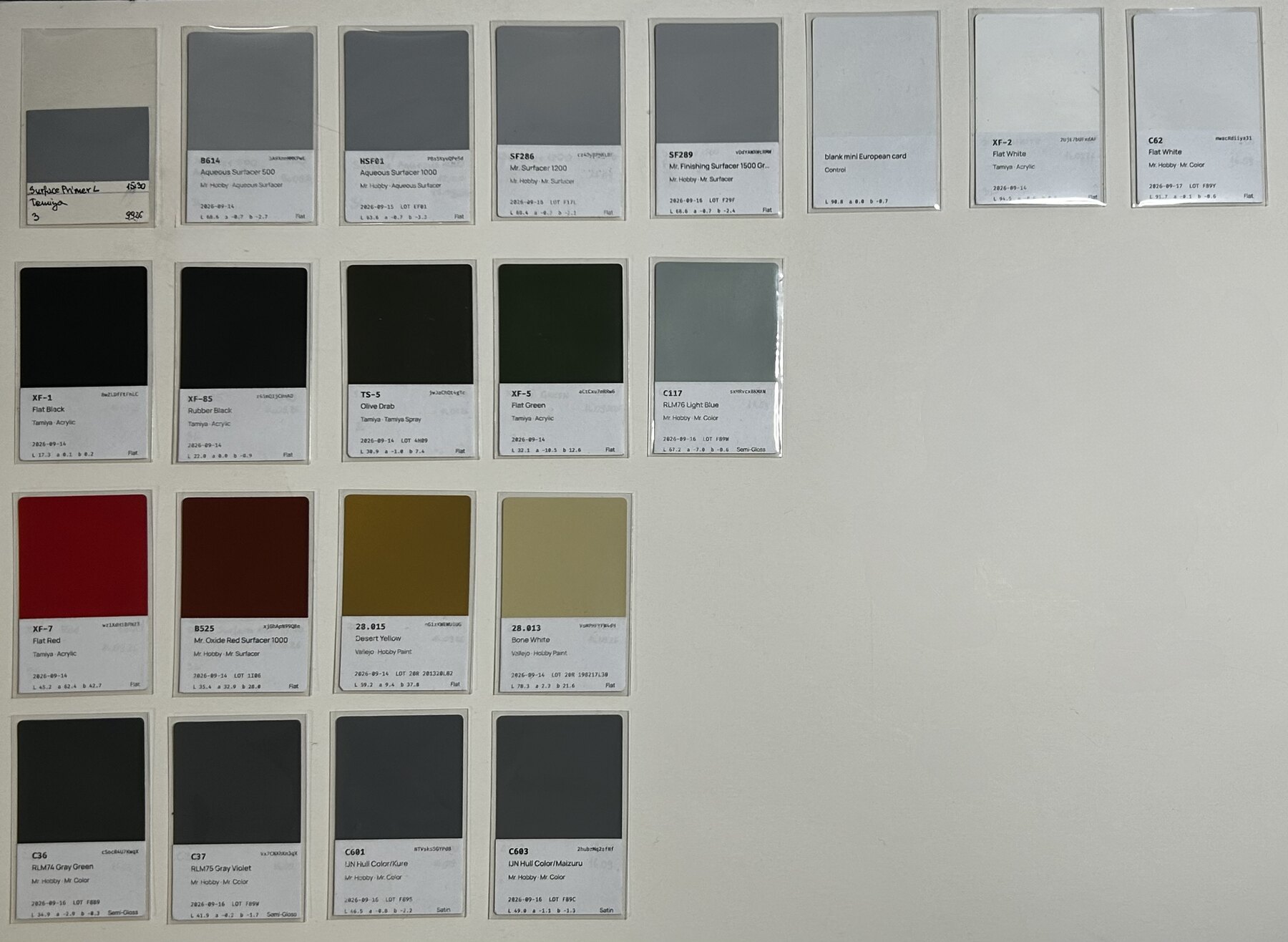
What do the official Mr. Hobby documents show?
We measured 5 Mr. Color colors and compared them with all 3 Mr. Hobby documents. The “Measured” column is the color measured on the sample. The other 3 columns give the value from each document and its distance from the measured color.
| Code | Measured | Catalog 2024-25 | Color chart 2026 | mr-hobby.com chart |
|---|---|---|---|---|
| C36 RLM74 Gray Green | 77,83,83C36 RLM74 Gray GreenMr. Hobby · Mr. Color#4D5353 · sRGB 77,83,83L*a*b* 34.8, -3.0, -0.6Measured 2026-09-18, ColorMunki PhotoOpen in Model Box → | 40,64,68C36 RLM74 Gray Green#284044 · sRGB 40,64,68Mr. Hobby catalog 2024-25 chip 8.7 | 78,83,75C36 RLM74 Gray Green#4E534B · sRGB 78,83,75Mr. Hobby color chart 2026 chip 1.2 | 88,90,77C36 RLM74 Gray Green#585A4D · sRGB 88,90,77mr-hobby.com range chart 3.2 |
| C37 RLM75 Gray Violet | 97,99,102C37 RLM75 Gray VioletMr. Hobby · Mr. Color#616366 · sRGB 97,99,102L*a*b* 41.8, -0.2, -1.9Measured 2026-09-18, ColorMunki PhotoOpen in Model Box → | 75,94,93C37 RLM75 Gray Violet#4B5E5D · sRGB 75,94,93Mr. Hobby catalog 2024-25 chip 3.9 | 98,87,101C37 RLM75 Gray Violet#625765 · sRGB 98,87,101Mr. Hobby color chart 2026 chip 3.5 | 103,91,95C37 RLM75 Gray Violet#675B5F · sRGB 103,91,95mr-hobby.com range chart 2.3 |
| C117 RLM76 Light Blue | 149,167,164C117 RLM76 Light BlueMr. Hobby · Mr. Color#95A7A4 · sRGB 149,167,164L*a*b* 66.9, -7.0, -0.9Measured 2026-09-18, ColorMunki PhotoOpen in Model Box → | 178,206,198C117 RLM76 Light Blue#B2CEC6 · sRGB 178,206,198Mr. Hobby catalog 2024-25 chip 11.6 | 151,174,169C117 RLM76 Light Blue#97AEA9 · sRGB 151,174,169Mr. Hobby color chart 2026 chip 2.0 | 167,185,185C117 RLM76 Light Blue#A7B9B9 · sRGB 167,185,185mr-hobby.com range chart 5.9 |
| C601 IJN Hull Color (Kure) | 108,111,115C601 IJN Hull Color (Kure)Mr. Hobby · Mr. Color#6C6F73 · sRGB 108,111,115L*a*b* 46.6, -0.9, -2.5Measured 2026-09-18, ColorMunki PhotoOpen in Model Box → | 129,134,144C601 IJN Hull Color (Kure)#818690 · sRGB 129,134,144Mr. Hobby catalog 2024-25 chip 8.0 | 129,134,144C601 IJN Hull Color (Kure)#818690 · sRGB 129,134,144Mr. Hobby color chart 2026 chip, unchanged artwork 8.0 | 139,142,147C601 IJN Hull Color (Kure)#8B8E93 · sRGB 139,142,147mr-hobby.com range chart 10.6 |
| C603 IJN Hull Color (Maizuru) | 113,117,118C603 IJN Hull Color (Maizuru)Mr. Hobby · Mr. Color#717576 · sRGB 113,117,118L*a*b* 48.8, -1.1, -1.5Measured 2026-09-18, ColorMunki PhotoOpen in Model Box → | 149,154,168C603 IJN Hull Color (Maizuru)#959AA8 · sRGB 149,154,168Mr. Hobby catalog 2024-25 chip 12.9 | 107,109,110C603 IJN Hull Color (Maizuru)#6B6D6E · sRGB 107,109,110Mr. Hobby color chart 2026 chip 2.5 | 123,124,118C603 IJN Hull Color (Maizuru)#7B7C76 · sRGB 123,124,118mr-hobby.com range chart 2.8 |
Median over the 5 codes:
- the 2026 chart is 2.5 from the paint,
- the mr-hobby.com chart 3.2,
- the 2024-25 catalog 8.7.
The 2026 chart and the mr-hobby.com chart cannot be told apart. With 5 codes the median is the third value in a short list. The 2 documents trade places code by code: the 2026 chart is closer on C36, C117 and C603, mr-hobby.com on C37, and on C601 both are the same unchanged artwork. Read them as one group at roughly 3.0, not as a ranking. The distance to the 2024-25 catalog, 3 times larger, is the difference that survives the sample size.
The catalog is also the document most databases copy from.
One more reading, not in the table: C62 Flat White measures 230,231,232C62 Flat WhiteMr. Hobby · Mr. Color#E6E7E8 · sRGB 230,231,232L*a*b* 91.5, -0.1, -0.7Measured 2026-09-18, ColorMunki PhotoOpen in Model Box →, L 92.7 in OKLab (91.5 in CIELAB) and neutral, while the catalog gives 255,255,255C62 Flat White#FFFFFF · sRGB 255,255,255Mr. Hobby catalog 2024-25 chip, a value no paint reaches: 7.3 from the measured white.
Before this session we valued whites at their darkest spots, as for every paint darker than the card. That biases a white toward the card stock and makes it look further from pure white than it is. Corrected, C62 is 1.3 from the bare card and 7.3 from #FFFFFF, and Tamiya XF-2 is 4.2 from the card. The conclusion is unchanged: no paint here reaches pure white. The earlier numbers were 0.1 to 0.5 higher.
Which source gets the color right?
The 3 manufacturer documents are not the only sources. Most of us do not open the PDF catalog but look the paint up on a website, and the website took its values from somewhere. We ranked every source we could find by its median distance from the measured color over the same 5 codes. The “Error range” column shows how uneven a source is: its smallest and largest distance from the measured color among those 5 codes. The 2026 chart, for example, has C36 at 1.2 and C601 at 8.0, so its median of 2.5 hides that range.
| Source | Median ΔE | Error range over the 5 codes | Notes |
|---|---|---|---|
| Mr. Hobby color chart 2026 (official PDF) | 2.5 | 1.2 to 8.0 | agrees where the chip has new artwork |
| mr-hobby.com range chart (official) | 3.2 | 2.3 to 10.6 | cannot be told apart from the 2026 chart at 5 codes |
| juhyxx/samec (GitHub) | 7.6 | 3.0 to 13.1 | |
| Mr. Hobby catalog 2024-25 (official PDF) | 8.7 | 3.9 to 12.9 | the most copied document |
| Scalemates | 9.9 | 1.5 to 15.3 | |
| Mech9 | 11.6 | 4.9 to 15.6 | love-p.jp and gundamplanet carry the same values |
| paint-vault.com | 12.0 | 4.9 to 15.7 | |
| Arcturus5404 / painthoarder | 12.1 | 4.9 to 15.8 | identical values |
The 2026 chart is closest to the paint, but not on every chip. A comparison of all 216 Mr. Color chips in both documents shows that 115 have identical artwork in the 2024-25 catalog and the 2026 chart, while about 100 received new artwork in 2026. The chips with new artwork agree with the paint: C36 to within 1.2, C117 2.0, C603 2.5. Among the unchanged chips the only measured example is C601, 8.0 off in both documents.
The manufacturer explains this in the description of the printed 2026 catalog in its own EOS Mr.HOBBY online shop, not in the chart itself: the chart was compared with the painted reference panels Mr. Hobby keeps in house, and wherever the tone deviated from the panel, the chip color was respecified.
Our measurements agree with this. Chips with new artwork agree with the paint, while the older artwork is off by up to 12.9 on the codes we measured. The manufacturer says nothing about a change in paint or pigment recipes, so this is a correction of the artwork, not of the paint.
The rest of the table consists of websites, which fall into 2 families. One traces back to Mech9, whose values are repeated by love-p.jp and gundamplanet. The boundary between the families is not sharp: Scalemates prints the Mech9 value on C37 and C117, and paint-vault carries the Mech9 C36 alongside its own.
The other family is shared by Arcturus5404, painthoarder and paint-vault to within 1 level out of 255 (differences between the raw numbers in the files are given in those levels; 1 or 2 levels are below the just-noticeable difference). Both families give a color darker and greener than the paint: their C36 is around #0A3D3EC36 RLM74 Gray Green#0A3D3E · sRGB 10,61,62Mech9 lineage value, while the paint measures #4D5353C36 RLM74 Gray GreenMr. Hobby · Mr. Color#4D5353 · sRGB 77,83,83L*a*b* 34.8, -3.0, -0.6Measured 2026-09-18, ColorMunki PhotoOpen in Model Box →. None of these values comes from a measurement. Each leads back to an older catalog page, that is, to the manufacturer’s artwork.
What does it look like in OKLab?
The tables above cover Mr. Color. The session also included 6 Tamiya paints and 2 Vallejo Hobby Paint sprays, and the question for each is the same: how far is each published catalog value from the final color of the paint? Figures 3 and 5 place them in OKLab. Figures 4 and 6 show 2 parts of each error side by side: the difference in lightness and the difference in chroma, that is, how strong the color is.
- measured paint
- Mr. Hobby documents
- Mech9 family
- Arcturus family
- Scalemates, samec
How to read Figure 3: the horizontal plane carries the a and b axes, green to red in one direction and blue to yellow in the other. Lightness L runs up the vertical axis. All 3 axes share one scale. The colored plane is a cross-section of the space at the average lightness of the points, cut off at the edge of sRGB, the range of colors a screen can show. The ringed dot with a code is the measured color of the paint. Each published value is connected to it by a thin line whose length in the space corresponds to the ΔE between them. On screen that line is foreshortened by perspective, so read the value from the tooltip on the dot.
The 2026 chart stays within ΔE=3.5 on 4 of the 5 codes, and the mr-hobby.com chart on 3. Both stay within 6 on 4 of the 5 codes, and C601 is the exception in both. The remaining sources lie 1.5 to 16 from the paint, with medians of 7.6 to 12. Their error lies almost entirely along the vertical axis: the hue roughly agrees, the lightness does not. The catalog, and every source that copies it, gives C36 too dark and C117, C601 and C603 too light.
- Mr. Hobby documents
- Mech9 family
- Arcturus family
- Scalemates, samec
How to read Figure 4: each bar is one published value. The left panel shows how much lighter or darker it is than the paint, the right panel how much more or less chroma it has, both in the same units as ΔE. Hue is not plotted, so the 2 panels are 2 separate readings and do not add up to the ΔE. Nearly all of the length falls in the left panel. Hover over a bar to see the source and the numbers.
- measured paint
- Tamiya documents
- Mech9
- Arcturus family
- Scalemates, samec
Figure 5 is read the same way as Figure 3. Over the 3 colors Tamiya’s own leaflets sit a median of about 8.0 from the paint and the websites 5.0 to 12.0. With 3 codes a median is just the middle value, so the per-code figures say more. Again the error is mostly in lightness. Every source gives XF-7 Flat Red lighter and with more chroma than it is, 4.0 to 12.0 from the paint depending on the source. XF-5 Flat Green is 8.0 to 16.0 from the paint in every source: the leaflets 15.0 too light, the Scalemates family 8.0 to 9.0 too dark. TS-5 Olive Drab, the spray, is 4.0 to 8.0 off. The 2014 Tamiya America chart is the closest Tamiya document to any of the 3, at 4.0.
White and the 2 blacks are omitted from Figure 5, because every source gives them as pure white or pure black. That stretches L from 0 to 100 and flattens everything else onto a single plane. They are in the bar chart below (Figure 6). XF-2 Flat White differs from the paint by 4.2 to 4.4 in every source. XF-1 Flat Black is pure black in 5 sources, 30.0 from the paint. XF-85 Rubber Black, a neutral gray of L 33 in the jar, is given as a brownish black, 9.0 to 12.0 too dark. The exception is the 2025 leaflet, which makes it pure black and is 33.0 from the paint.
- Tamiya documents
- Mech9
- Arcturus family
- Scalemates, samec
How to read Figure 6: the same way as Figure 4. Bars beyond ±20 are cut off and labeled. Blacks given as #000000 have −30 in lightness and 0 in chroma.
The Vallejo Hobby Paint 2026 catalog differs from the paint by 0.9 for Bone White and 2.9 for Desert Yellow, and the website values differ from the catalog by at most 2 levels out of 255 per channel, so they give the same result. Desert Yellow also has the largest spread in this set: 0.6 among its 3 valued spots, so that 2.9 is the least certain number here. 2 paints are not enough to assess a whole range, but this is the only case in this session where a published chip and the paint agree without any change to the artwork.
For all 3 manufacturers the error is mostly in lightness, and both copy families are further from the paint than the documents they copied from.
The edges of the sRGB gamut, the lightest, darkest and most saturated colors a screen can show, reveal most clearly where catalog values come from. Every source gives XF-2 as 255,255,255, most give XF-1 as 0,0,0, and the Arcturus family, with Scalemates, gives XF-7 as pure red. These are values entered by a graphic designer and never measured. No paint reaches pure white, black or red. For black, the file format also affects the numbers. The 2021 Tamiya leaflet stores its blacks as 100 % K, which poppler renders as 35,31,32. The 2025 leaflet is a JPEG page and gives 0,0,0. So the same artwork yields 2 different numbers, depending on which program opened the file.
What about the surfacers, which have no chip?
Mr. Hobby gives no color for any of its 30 surfacers, in any document. The missing values are given by only 2 unofficial sources, and they disagree with each other.
| Product | Measured CIELAB L* a* b* | Mech9 | paint-vault |
|---|---|---|---|
| Mr. Surfacer 1200 | 66.8, -0.7, -2.2SF286 Mr. Surfacer 1200Mr. Hobby · Mr. Surfacer#A0A3A6 · sRGB 160,163,166L*a*b* 66.8, -0.7, -2.2Measured 2026-09-18, ColorMunki PhotoOpen in Model Box → | 21.1 given as L* 91 | white chip |
| Aqueous Surfacer 500 Spray | 68.4, -0.8, -2.6B614 Aqueous Surfacer 500 SprayMr. Hobby · Aqueous Surfacer#A4A7AC · sRGB 164,167,172L*a*b* 68.4, -0.8, -2.6Measured 2026-09-18, ColorMunki Photo | no value | white chip |
| Aqueous Surfacer 1000 | 63.0, -0.8, -3.5HSF01 Aqueous Surfacer 1000Mr. Hobby · Aqueous Surfacer#95999F · sRGB 149,153,159L*a*b* 63.0, -0.8, -3.5Measured 2026-09-18, ColorMunki PhotoOpen in Model Box → | 9.0 | white chip |
| Mr. Finishing Surfacer 1500 Gray | 67.9, -0.8, -2.6SF289 Mr. Finishing Surfacer 1500 GrayMr. Hobby · Mr. Surfacer#A2A6AA · sRGB 162,166,170L*a*b* 67.9, -0.8, -2.6Measured 2026-09-18, ColorMunki PhotoOpen in Model Box → | 9.4 too light | 9.0 too dark |
| Mr. Oxide Red Surfacer 1000 | 34.7, 33.2, 28.7B525 Mr. Oxide Red Surfacer 1000Mr. Hobby · Mr. Surfacer#843826 · sRGB 132,56,38L*a*b* 34.7, 33.2, 28.7Measured 2026-09-18, ColorMunki PhotoOpen in Model Box → | no value | 2.9 |
Mech9 is off on the grays by 9 to 21. paint-vault gives a white chip for 3 of the 4 and is off by 9 on the fourth. On Finishing 1500 the 2 sources err in opposite directions. Oxide Red is the only row where an unofficial source is close to the paint.
Read at 10 spots per card, the 4 grays are clearly different from one another. Read at 1 spot, the differences between them fell within the measurement error and they looked like one color. Mr. Surfacer 1200 and Finishing Surfacer 1500 are 0.9 apart, while 2 cards sprayed from the same jar differ by 0.1. The difference between them is therefore 6 times the spray-to-spray error and cannot be attributed to the method. Whether they are nonetheless one pigment, that is, the same spectral shape at different lightness, is not a question the color values can answer. It belongs to the spectra, and those are in the session data below.
What else came out of the session?
- 5-year-old cans still agree with their catalog chip. The 2 Vallejo Hobby Paint sprays, bought in April and May 2021, differ from the 2026 catalog by 0.9 and 2.9.
- The same paint sprayed twice reads almost the same. TS-5 Olive Drab, sprayed from one can 5 days apart onto 2 cards, reads 0.2 apart; XF-1 Flat Black from one jar, 0.2; Mr. Surfacer 1200, 3 sprays from one jar, 0.15 to 0.4. Cards sprayed with the same paint never give exactly the same reading. The difference between them is about 0.2, and that is the smallest difference this method can resolve: anything below it is spray-to-spray error, not a difference between paints. The gaps between sources are roughly 40 times larger. We previously reported 2, but that number came from reading 1 spot per card.
- One source can give 2 values for the same code. paint-vault gives C36 twice, as #063C3E and #0A3D3E. Scalemates gives each Tamiya XF code 3 times, and the 3 chips differ from one another by up to 45 levels out of 255 on one channel.
- The 2021 and 2025 Tamiya leaflets agree with each other, with 2 exceptions. On every chip examined except XF-7 and XF-15, they differ by at most 5 levels out of 255 per channel.
- Rubber Black is gray. XF-85 measures a neutral L 33, and every source gives it as a brownish black.
- Tamiya jars have no lot number. Only the spray cans have one, so for the jars there is nothing to record.
What this study does not show
With one jar per code, batch-to-batch variation was not examined. Lot numbers and purchase dates are recorded for every sample, except Tamiya jars (see above). The Mr. Color jars were 2 to 3 weeks old on the day of painting. The 2 Vallejo cans were 5 years old. We measured 5 Mr. Color codes. The conclusions about the other 211 are based on the artwork comparison. 6 Tamiya paints and 2 Vallejo sprays are enough to show the pattern, but not enough to assess a whole range.
On the catalog side we deliberately used the PDF rather than the printed page: the fill in the file is the value the designer entered, and the same value every database copies, with no printing press, paper or scanner in between. Both Mr. Hobby documents are files prepared for print (PDF/X), in which every chip is a recipe of printing inks in CMYK, not a screen color. The sRGB numbers that we and every website read from them exist only after conversion from CMYK, in our case by poppler. We checked that conversion using the print profile declared in the file: individual values shift by 1 to 3 ΔE in either direction, the median by 0.3, and no conclusion changes. These files are therefore a copy prepared for print, not a chart a modeler can rely on when viewed on screen. We have not yet measured the print itself.
Every paint covered the card with the first coat, and the 2 further coats only added thickness. Opacity would matter for clear and translucent paints, and none were included in this session. The instrument has not yet been checked against a certified reference tile.
What we do with this in Model Box
Every value in the database has its provenance recorded: a color measured on a sample is marked as a measurement, a color taken from a chart records which document it came from, and the app will show that difference. Mr. Color has been re-read from the 2026 chart, all 215 color rows - the chart’s clear coats are not stored as paints. The measured values from this session, the gray surfacers among them, are being loaded now - no other internet source gives those correctly.
In short: where Mr. Hobby redrew a chip for the 2026 chart, the chip agrees with the paint within the Model Box default tolerance of 3.0. The older artwork in the 2024-25 catalog, and everything that copies it, describes a catalog page from 2024 and lies 8 to 13 from the paint. The manufacturer redrew about half of its chips after comparing the chart with its own painted reference panels, but mentions this only in the description of the printed catalog in its shop. Whether the other 115 unchanged chips are as far from the paint as C601, 8 or more, requires another measurement session.
Sources
Official documents, read in September 2026. GSI Creos, Mr. Hobby 2026 color chart, vector fill of each chip. Description of the GSI Creos general catalog 2026 in the EOS Mr.HOBBY shop run by GSI Creos, as of the end of March 2026, with a note in Japanese about comparing the chart with reference panels and respecifying the colors where the tone deviated. GSI Creos general catalog 2024-25, the same artwork as the English color list, vector fill of each chip. C1-C189 range chart and the C601-C609 strip on mr-hobby.com, median of each chip interior. Tamiya paint leaflets of May 2021 (vector) and May 2025 (JPEG page), median of a band inside each hexagonal chip. Tamiya USA XF chip photo, Wayback Machine capture of 2021-09-27. Tamiya America, TS chart 2014, vector fill. Vallejo Hobby Paint catalog 2026, vector fill.
Website values, as published on each site, read in September 2026: paint-vault.com, mech9.com and its Japanese mirror, Scalemates, Arcturus5404/miniature-paints and juhyxx/samec on GitHub, and painthoarder.com. 5 codes per source for Mr. Color. Tamiya coverage depends on the source, and Scalemates has up to 3 entries per code.
Method: Björn Ottosson, A perceptual color space for image processing (2020), the OKLab definition. Lilley, Verou and Atkins-Bittner (eds.), CSS Color Module Level 4, W3C 2022, for the just-noticeable difference of 2 on this scale. ArgyllCMS 3.5 for spotread and spec2cie. X-Rite ColorMunki Photo, 45°/0°, 400 to 700 nm in 10 nm steps, M2; ArgyllCMS writes 380 to 730 nm into the files and the bands outside the specification are not used; agreement and repeatability figures from X-Rite and the retail specification.
Data: the sample log with lots, dates, coat counts and thinning, the card values with their coverage flags, the blank-card reference, and the 3 valued spots of every card as ArgyllCMS spectra, 57 in all - enough to recompute every number above for any illuminant or observer: zip. The other 7 spots of each card are not published. The data is released under CC BY-NC-SA 4.0: non-commercial use, with attribution to Model Box, under the same license.