Mr. Hobby grey surfacers - one pigment after all?

Paweł Krystkiewicz
Mr. Hobby, that is GSI, sells grey surfacers in four grades (500, 1000, 1200, 1500) and two solvents, but its catalogues give no color for any of them. The color of a surfacer matters, and not only because it shows through: under preshading, under thin camouflage coats, on the test piece of plastic. A surfacer can also be the final color on the model. Vallejo works that way, offering surfacers in several colors, for instance 70.605 German Red Brown 87,51,5270.605 German Red BrownVallejo · Primers#573334 · sRGB 87,51,52Database valueOpen in Model Box → or 70.608 USA Olive Drab 85,86,7370.608 USA Olive DrabVallejo · Primers#555649 · sRGB 85,86,73Database valueOpen in Model Box →. It is worth having those colors in the app to compare against the target color on the model. Online sources are no help here either, since they disagree on the values for these colors.
For our test we prepared 4 samples - one per surfacer grade - and measured the reflectance spectrum with the instrument from the catalog study, which carries the method and the session data in full. We then divided each spectrum by its own mean and overlaid them on one chart.
The result: the four GSI surfacers share one spectral shape, consistent with a single pigment recipe, and differ only in lightness. Two charts follow: Figure 1 shows the raw reflectance spectra of five surfacers (Tamiya as a control color), Figure 2 the same spectra divided by their own mean. We also added the measurement error from the instrument data, but it is so small it is barely visible.
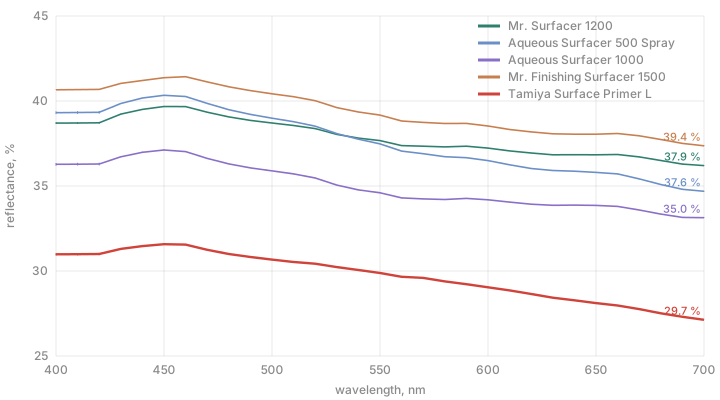
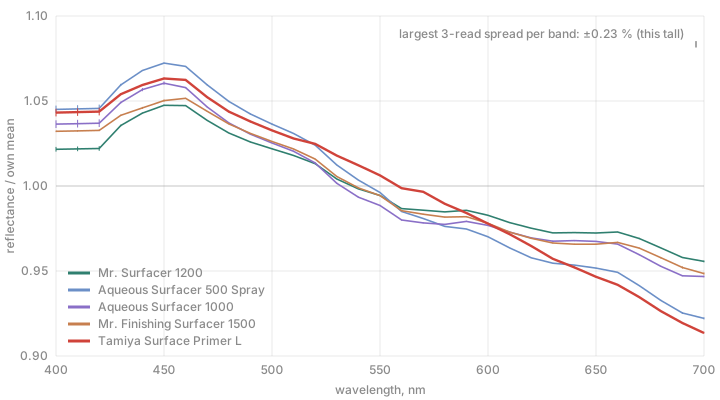
In Figure 1 the four GSI greys sit at four levels, 35 to 39 % mean reflectance, and Tamiya below them at 30%. In Figure 2 each curve is divided by its own mean, so a perfectly neutral grey would be a flat line at 1.00, and the departures from that line depend on the pigment’s coloration along the OKLab a (green-red) and b (blue-yellow) axes. All four GSI greys have the same shape: a maximum at 440 to 460 nm and a slow fall towards the reds. Does the chemistry change anything? The lacquer (C series) and water-based (H series) curves coincide. The Tamiya Surface Primer L curve, in red, has a different shape: above the GSI curves between 520 and 580 nm and below them from 620 nm up.
The measurement error is the spread of three reads of the same sample in each band. Each curve is the average of those three reads. The largest error is ±0.23 % of a curve’s own mean, which is ±0.08 points of reflectance. Most are thinner than the line width, so the differences between the curves are not measurement noise.
The five averaged spectra are available in surfacer-spectra-2026-09-10.csv, reflectance in percent for every 10 nm band from 400 to 700 nm, under the same CC BY-NC-SA 4.0 license as the rest of the session data.
Why RMS?
The reflectance level depends on how much pigment is in a coat and how much white it carries against black. The shape of the curve depends on which pigment we are looking at, because absorption bands do not move when more of the same material is added. Normalisation removes the level and keeps the shape. Two paints that share a curve after normalisation are consistent with one pigment recipe. Two paints with different curves cannot be explained by pigment quantity alone.
Shape RMS reduces that comparison to one number. For each paint we take the difference between its normalised curve and the mean curve of the four GSI surfacers in each of the 31 bands from 400 to 700 nm, square it, average, and take the root. The result is the average departure from the shared shape, as a percentage of the curve’s own mean reflectance - the units of Figure 2, not points of reflectance. Zero means an identical shape, and the higher the value, the further the curve strays. RMS says how much a curve strays but not where: two paints with similar RMS can stray in different bands, so next to the number we also look at the run of the curve in Figure 2.
Measurement results
The table lists the five samples: CIELAB as read by the instrument, mean reflectance over 400 to 700 nm, and the shape departure from the GSI mean curve.
| Product | CIELAB L* a* b* | Mean reflectance | Shape RMS from the GSI mean |
|---|---|---|---|
| Mr. Surfacer 1200 | 67.8, -0.5, -2.1SF286 Mr. Surfacer 1200Mr. Hobby · Mr. Surfacer#A3A5A9 · sRGB 163,165,169L*a*b* 67.8, -0.5, -2.1Measured 2026-09-10, ColorMunki PhotoOpen in Model Box → | 37.9 % | 0.8 % |
| Aqueous Surfacer 500 Spray | 67.5, -1.1, -3.2B614 Aqueous Surfacer 500 SprayMr. Hobby · Aqueous Surfacer#A1A5AA · sRGB 161,165,170L*a*b* 67.5, -1.1, -3.2Measured 2026-09-10, ColorMunki PhotoOpen in Model Box → | 37.6 % | 1.2 % |
| Aqueous Surfacer 1000 | 65.5, -0.4, -2.7HSF01 Aqueous Surfacer 1000Mr. Hobby · Aqueous Surfacer#9D9FA4 · sRGB 157,159,164L*a*b* 65.5, -0.4, -2.7Measured 2026-09-10, ColorMunki PhotoOpen in Model Box → | 35.0 % | 0.3 % |
| Mr. Finishing Surfacer 1500 Gray | 68.8, -0.7, -2.4SF289 Mr. Finishing Surfacer 1500 GrayMr. Hobby · Mr. Surfacer#A5A8AC · sRGB 165,168,172L*a*b* 68.8, -0.7, -2.4Measured 2026-09-10, ColorMunki PhotoOpen in Model Box → | 39.4 % | 0.3 % |
| Tamiya Surface Primer L (87042) | 61.4, -1.1, -2.487042 Surface Primer L GrayTamiya#919598 · sRGB 145,149,152L*a*b* 61.4, -1.1, -2.4Measured 2026-09-10, ColorMunki Photo | 29.7 % | 1.3 % |
RMS, the root mean square, in the last column is computed as described above. The GSI family sits within 0.3 to 1.2 % of its own mean. Aqueous 500 is the furthest, and its departure leans one way: a touch more blue, a touch less red, in line with its b of -3.2. This may come from imperfect mixing of all the pigment in the jar, part of which was visible at the bottom before stirring.
Tamiya, another maker and an entirely different recipe, is in the table as an external reference point: 1.3 %, with its own shape, above the family between 520 and 580 nm and below it from 620 nm up. We measured the one Tamiya sample we had to hand.
Between the four GSI greys only the reflectance level differs, that is the lightness. Lightness L runs from 70.3 to 73.2, at the same recipe and probably a slightly different pigment load depending on how well the paint was stirred. L here and below is OKLab lightness on the 0 to 100 scale, the same one ΔE is computed on; the table lists CIELAB L*a*b*, the instrument’s native output. The 500, 1000, 1200 and 1500 labels are the filler grade and appear to be the only thing that sets these products apart, if we assume they share one pigment, which these results seem to confirm.
The chart below (Figure 3) places the same five samples in OKLab - the space Model Box computes ΔE in. All three axes share one scale. Drag to rotate, zoom to separate the top four, tap a dot for the numbers.
- measured paint
All five points sit on one vertical line: a and b agree to within 0.3, so hue and chroma are shared and only lightness changes. The four GSI span L 70.3 to 73.2, with ΔE from 0.4 to 2.9 between any pair. Tamiya sits below them at L 66.7, ΔE 3.5 to 6.4 from the GSI family. To a color database it is a fifth grey, darker than the others, of the same hue.
Tamiya Surface Primer L serves as the reference point in the charts. It is another maker’s product with a different recipe; it is darker: L 66.7 against 70.3 to 73.2, and its curve has a different shape: above the GSI family between 520 and 580 nm and below it from 620 nm up, at 0.91 by 700 nm against 0.92 to 0.96. Whether Tamiya’s own surfacers share one grey among themselves would need a separate study.
What this means at your bench
- Working with Mr. Hobby surfacers, choose by grade and solvent. 500, 1000, 1200 and 1500 are close enough to use as fillers of different grit on the same model. The largest difference here, Aqueous 1000 against Finishing 1500, is 2.9 in L and nothing in a or b, that is ΔE 2.9. A later session read the same jars at ten moved spots per card instead of one, and puts that pair at 4.2 - past the default tolerance of 3. So: close, not identical. Under a covering coat it will not show; as the final color on a model, pick one grade and stay with it. ΔE is the same number Model Box shows for every match; more on color similarity.
- Aqueous and lacquer look like one grey, with a caveat. All four share one spectral shape whichever solvent they carry, but no grade was sampled in both chemistries here, so this session cannot separate the solvent from the filler grade. On the level they still differ: 0.4 to 2.9 between any pair.
- Online surfacer values are unusable. Mech9 puts Mr. Surfacer 1200 at L ≈ 92, paint-vault gives nothing (a white chip), and on Finishing 1500 both miss in opposite directions - Mech9 by 9.4 too light, paint-vault by 9.0 too dark, measured against the ten-spot value of the later session. In Model Box we have the correct, measured values.
Method
Every number in this post comes from the measurement session of 2026-09-10 (Figure 4 is a photo taken at the later session): three coats on a white card, about 20 hours to dry, one spot per card, read three times with the head held still, and averaged. Three still-head reads measure the instrument, not the card; a later session established that moving the head across one card changes the reading by up to 1.7 ΔE, and it re-reads these same jars at ten moved spots each. The values below are therefore a single point on each card. Two of these products were sprayed again for the later session: Aqueous Surfacer 1000 moves about 2 between its two cards, Aqueous Surfacer 500 Spray about 0.8. The shape comparison that follows is the part to treat with most caution, and the post’s limit is the one already stated below: one card per product. Full spectrum kept. Measured 2026-09-10 on an X-Rite ColorMunki Photo, 400 to 700 nm in 10 nm steps, the instrument’s specified range; ArgyllCMS writes 380 to 730 nm into the files and the outer bands are not used. One card per product, so spread between paintings is outside the scope of this study. The measurement error describes only the noise between reads. The exception is Mr. Surfacer 1200: sprayed twice from the same jar, the second time with more thinner and better flow; the first sample, with an uneven, frosted coat, stayed out of the tables, and the two reads differ by 0.3 - the only repeat painting in this session (Figure 4).

In short: it looks like Mr. Hobby makes its grey surfacers from the same pigment and sells them in four grades. So why is that color not declared in the GSI catalogue? From the manufacturer’s side the arrangement is rather convenient - no color standard is defined beyond generic names like “White”, “Black”, “Mahogany” or “Pink”. Nobody even mentions grey - “Mr. Surfacer 1200” has no “grey” in its name at all. The one exception is SF-289 “Mr. Finishing Surfacer 1500 Gray”, but that could just as well be an intern rushing the label artwork to print, and so it stayed. Not saying what color to expect from a grey surfacer cuts the cost of quality control considerably, because there is nothing for the manufacturer to hit. A professional Japanese company surely has internal standards for that color with a tolerance across the visible spectrum, but none of it made it into the official Mr. Hobby catalogues, so there is nothing to refer to.